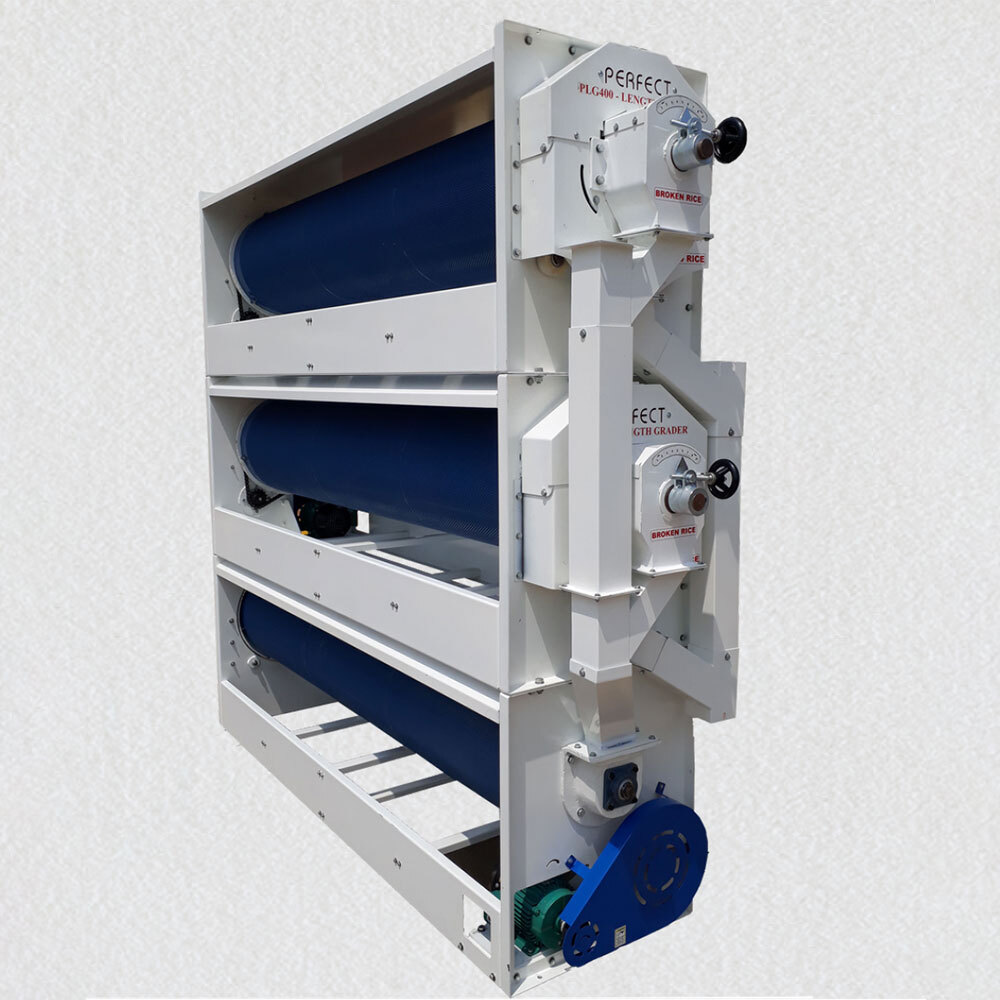
About Rice Length Grader-PLG 400
Salient Features
- Accurate separation of brokens.
- Compact size - space saving.
- Worm-geared drive - maintenance- free.
- VFD can be provided for better grading accuracy.
- The regrading system helps to separate head rice from brokens.
| Model No. |
Capacity of Rice, TPH |
Power, HP x RPM |
Overall Dimension in MM (L x W x H)
|
Weight in Kgs (App.) |
| PLG 2 - 400 x 1 |
1 |
1 |
3100 x 800 x 1000 |
300 |
| PLG 2 - 400 x 2 |
2 |
2 |
3100 x 800 x 1800 |
620 |
| PLG 2 - 400 x 3 |
3 |
3 |
3100 x 800 x 2600 |
940 |
Efficient Grain SeparationThe PLG 400 employs four precision-engineered cylinders, each 400 mm in length, to achieve accurate separation of broken and full rice grains. Its uniform feeding mechanism allows adjustment of feed rate for optimal throughput and consistent grading results, enhancing overall product quality and reducing waste.
Designed for Reliability and SafetyBuilt with a rugged mild steel frame and special alloy cylinders, the PLG 400 features overload protection and an emergency stop for operator safety. Its manual lubricating system, easy-to-access service areas, and corrosion-resistant finish contribute to both safety and operational longevity.
Flexible Integration for Rice ProcessingEngineered for rice mills and food processing units, the PLG 400 is installed as a stationary, floor-mounted unit. The multiple discharge ports facilitate efficient batch handling of various grain sizes, streamlining downstream processing or packaging tasks and increasing productivity in industrial environments.
FAQ's of Rice Length Grader-PLG 400:
Q: How does the Rice Length Grader-PLG 400 separate broken and whole rice grains?
A: The PLG 400 utilizes a set of four 400 mm alloy steel cylinders that rotate to separate rice grains by length. Uniform feeding and high-precision engineering ensure broken grains and whole grains are accurately sorted and discharged through multiple outlet ports.
Q: What maintenance and cleaning processes are required for the PLG 400?
A: Maintenance is straightforward due to easy-access service points. Routine tasks include manual lubrication, cleaning residue from the cylinders and belts, and checking the belt's alignment. Its corrosion-resistant powder-coated finish further simplifies upkeep.
Q: When should the PLG 400 be used within a rice processing facility?
A: The PLG 400 is best positioned after initial rice milling and before packaging, where length grading is essential for separating full grains from broken pieces, ensuring product quality meets market specifications.
Q: Where is the PLG 400 typically installed, and how portable is it?
A: This model is stationary and floor-mounted, designed for permanent installation in rice mills or food processing units. It is not portable due to its large dimensions (2200 x 900 x 1800 mm) and weight (approx. 700 kg).
Q: What safety features are included to protect operators during use?
A: Operator safety is prioritized with the inclusion of overload protection and an emergency stop switch. The low-noise design and manual lubricating system also ensure a safer working environment.
Q: How does the use of food-grade PVC belts and special surface finishes benefit the grading process?
A: Food-grade PVC belts ensure safe, hygienic handling of rice, while the corrosion-resistant and powder-coated surfaces prevent material degradation, contributing to long-term, trouble-free operation.





 Send Inquiry

 Send Inquiry
 Send Inquiry